One input, one real decision
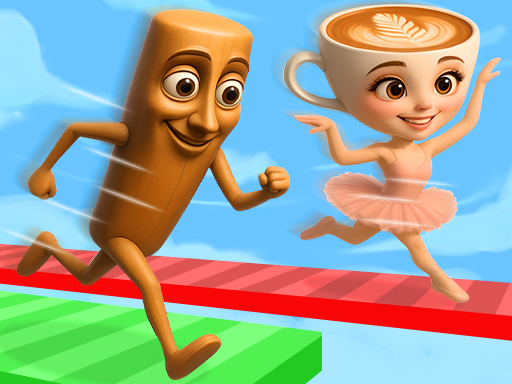
Brainrot Bridge Race 3D and Brainrot Mob Clash 3D both run at 1334x750, both carry the running and battlefield tags, and both list exactly one instruction: mouse click or tap to play. There is no jump button, no attack button and no sprint. Steering is the entire input surface.
That constraint is what makes the genre readable. When you can only choose a lane, every decision you make is a decision about when to stop collecting and start advancing, and the games are built as a sequence of three phases around exactly that question.
Phase one: the grab window
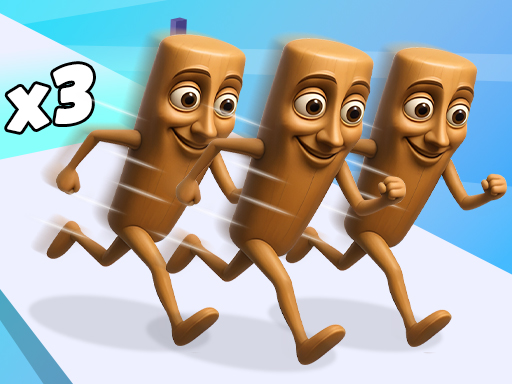
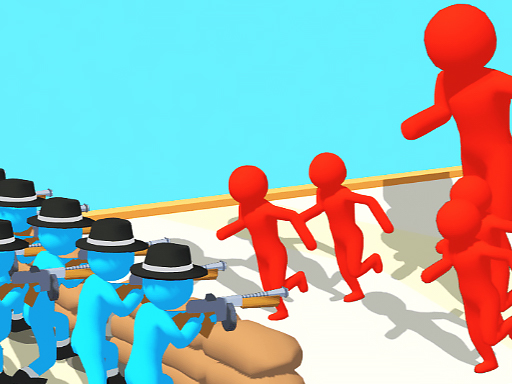
Early in a lap, detouring is free. Nobody is far enough ahead for lost distance to matter, so anything collectible in a side lane is worth taking. In Bridge Race you are gathering bananas, and collecting more evolves your form outright - so early greed compounds, because a better form makes later collection faster. In Mob Clash you are picking up brainrot characters that grow your stickman count and can then be matched and merged into stronger units.
The grab window closes at a specific moment: when a detour costs more distance than the pickup will return before the race ends. Most players close it far too late. The clean signal to watch for is your own conversion rate - once a pickup no longer changes what you can do (another banana that does not trigger an evolution, another unit that does not complete a merge), the window is shut.
Phase two: what happens when you lose stock
This is where the games separate. Crowd Evolution! makes loss brutal and legible. At 800x600 you grow by absorbing crowds of the same colour, but larger crowds absorb you, and there is a timer on the whole map - so every loss costs you both the stock and the seconds you spent acquiring it, and there is no time to re-earn both. Its counterplay is entirely positional: you cannot fight back, so the only response to a bigger rival is a route that never intersects theirs, which is why the colour gate matters so much. A wrong-colour crowd is not just worthless, it is a route you are wasting.
Mob Clash makes loss lumpy rather than linear, which is the more interesting design. Because units merge into powerful ones, losing a merged unit costs more than the sum of the pieces that went into it - you lose the parts and the merge work at once. The practical implication is counterintuitive: holding unmerged units is safer going into a contested stretch, and merging is something you do just after clearing danger, not just before entering it.
Mob Clash also runs a hazard layer the others do not - spikes and spinning saws on the course itself - so you can lose stock to the geometry with no rival involved at all.
Phase three: the finish-line flip
Near the end, accumulation stops paying, because there is no longer enough track left to convert stock into an advantage. The optimal line flips from greedy to direct, and it flips suddenly rather than gradually.
Bridge Race makes this easy to feel because evolution is discrete: if you are not going to reach the next form before the line, additional bananas do nothing for the result. Crowd Evolution makes it hardest, because the win condition is being the biggest crowd when the timer expires - there is no line to cross, so the flip never fully arrives and greed stays correct until the last second. Those are genuinely different endgames, and playing them back to back is the fastest way to internalise the difference.
The control case with no phases at all
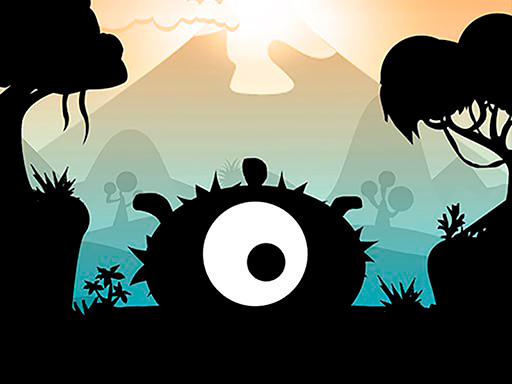
Shadowman Runner is worth playing alongside these three precisely because it strips the structure out. It is a 2D endless runner at 1920x1080 in a black silhouette style, the character runs automatically, and your only input is press to jump over obstacles. You collect potions for points, but there is no rival, no finish line and no merge - so the grab window never closes, loss counterplay does not exist, and there is no flip.
What remains is pure obstacle timing. If you play it after Mob Clash the difference is stark: one game asks what you should be carrying, the other asks only whether you jumped at the right moment. Neither is better, but knowing which one you are in the mood for saves a lot of frustration.
More in /category/meme/ and /category/chaos/.