Two phases that want opposite things from you
A pure obstacle course only ever asks one question: where do I put my body next. A pure tower defence asks a different one: where do I spend, and in what order. The hybrids sit between the two, and the interesting design problem is the seam - you have to decide when to stop moving and start committing resources, and the game usually will not tell you.
The tell for a good hybrid is that the movement phase buys something. If running around only kills time until the next wave, the two halves are stapled together. If running around determines what you can afford to place, the seam is real.
What each of these four is actually defending
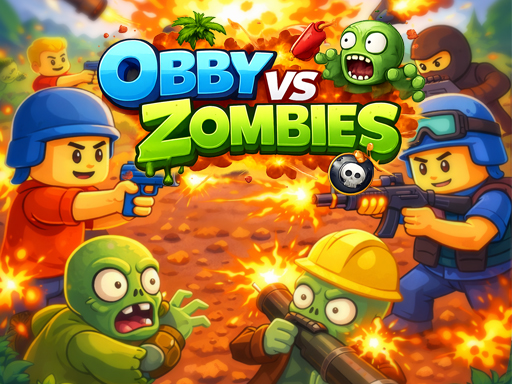
Obby vs Zombies defends a maze. It runs at 1024x768 and its core verb is construction: you assemble mazes out of different characters to slow and break incoming zombie hordes, then vary the attack and defence mix across runs. The controls are mouse or touch only, with no movement keys at all, which is the clearest possible signal about where the design weight sits - this one keeps the obby aesthetic and the roblox-style cast but hands the whole game to placement decisions. Treat it as the defence end of the spectrum.
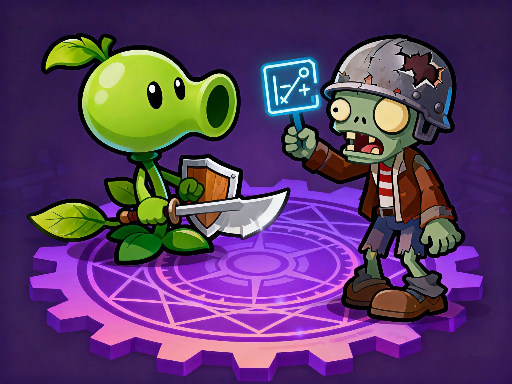
Plant Merge: Zombie War defends a garden, and its resource phase is a merge board. At 800x600 it asks you to combine plants into stronger plants between waves, so the question is never simply “can I afford another unit” but “do I spend two weak units to get one strong one, and can I survive the wave I am mid-merge on.” That is a genuinely different pressure from ordinary tower defence, where a purchase is instantaneous. Merging costs you board presence in the moment in exchange for board presence later.
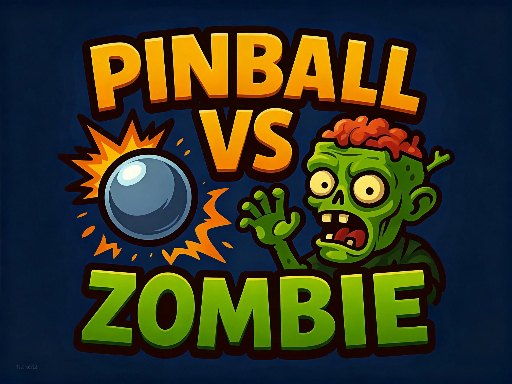
Pinball VS Zombie defends a house and outsources the aiming to physics. Also 800x600, it lays defensive flora out on a grid and then fires high-speed pinballs into that grid; the balls ricochet off your plants, and each impact triggers a bullet barrage into the undead waves. Sunlight auto-collects, so you are not micromanaging income - you are shaping a bounce geometry. Placing a plant is really placing a bumper, which means the best position is often not the one nearest the threat but the one that keeps the ball alive longest. Tap to plant, watch the sunlight meter, and think in angles.
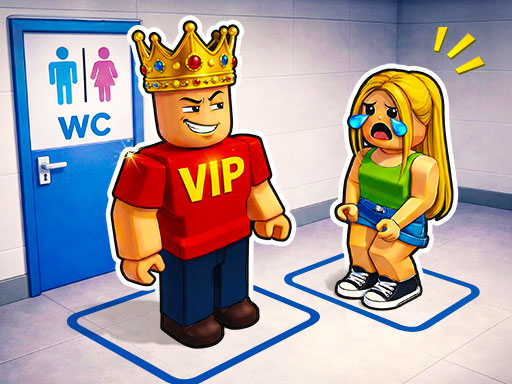
Obby Toilet Line defends something no other game here defends: a position in a queue. It runs at 960x600 and opens in a gas-station restroom line roughly thirty characters long, stretching past the store entrance. The progression is explicitly idle-style - where you stand in the line determines how much you earn - so the thing you are holding is a rank, and the thing that threatens it is other characters advancing. It is tagged idle and maze rather than defence, and that combination is accurate: the pressure is economic, not violent.
Its controls are the most elaborate of the four, and they encode the hybrid directly. Player 1 moves with WASD, uses Space to both jump and skip a place in line, E to interact, F to hit bugs and Left Shift to sprint. Player 2 uses the arrow keys, K to skip and interact, L to jump and hit bugs, and J to sprint. Note that one key does double duty in each set - Space is movement and progression at the same time for Player 1, K is the same for Player 2 - so the two phases are not separated by a mode switch at all. You never stop doing both.
Reading the seam
Lined up, the four form a clean gradient. Obby vs Zombies is placement with obby dressing. Plant Merge is placement where the economy is a puzzle. Pinball VS Zombie is placement where the economy is automatic and the geometry is the puzzle. Obby Toilet Line is movement where the defended asset is abstract.
If you are coming from pure obby games and want the shallowest step across, start with Obby Toilet Line, because you keep your movement keys and the defence layer is economic rather than combat. If you want to go straight to the other end, Obby vs Zombies removes movement entirely and you can judge in one wave whether placement games are for you.
More of this shelf sits in /category/obby/ and /category/survival/.