Three beats, repeated until you fall
The colour elimination round is one of the most copied formats in browser gaming, and it only has three beats. A colour is announced on screen. A short countdown runs. Every tile that is not that colour drops away. Survive, and the loop restarts immediately with a new colour and usually a shorter countdown.
It is a direct descendant of the elimination-game television format - a floor of tiles, an instruction, a timer, and no second chance - and it survives the port to browser because it needs no scoring system, no lives and no tutorial. You understand it in one round.
The skill is visual search, not reaction speed
This is the part most players get wrong. The clock in these games is generous by reflex-game standards; you are not being asked to respond within a fraction of a second the way you are in a timing bar. What actually eliminates you is the second half of the task: after you have read the colour, you still have to find the nearest tile of that colour in a field of distractors and plot a route to it that does not cross a tile about to vanish.
That is a visual-search problem, and it degrades in a specific way. When the safe colour is rare on your half of the floor, search time grows sharply, and when two of the palette’s colours are close in hue, you will start pathing toward the wrong one before your eyes correct. Good players do not react faster - they stand somewhere with more colour variety within one jump, so the search radius stays small.
The practical drill follows from that: stop sprinting for the centre of the announced colour cluster and start positioning between clusters between rounds. Idle position is the variable you control; reaction time is not.
The two versions here are not the same game
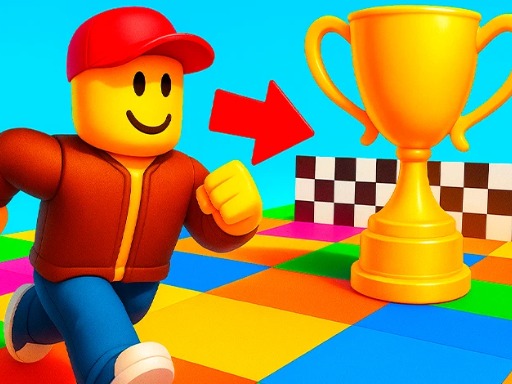
Robbie: Stand on the Right Color! runs at 800x600 and is tagged as parkour and run. Its control scheme is WASD plus mouse, and its framing is a race - reach the finish line first and set a record. The design detail that matters is that platforms disappear a few seconds after the call, so hesitation is the failure state rather than misidentification. It is the more movement-heavy of the two, and the parkour tag is earned: you are covering ground between rounds, not just standing and stepping.
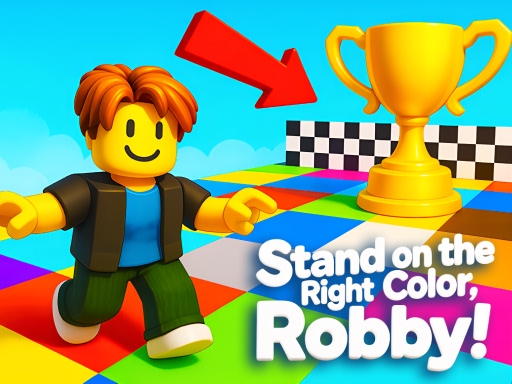
Stand on the Right Color, Robby! is also 800x600 but reads as an arcade race rather than a course. Its controls are broader - WASD or right mouse button to move, Space or left mouse to jump, and the mouse to look around - and that free camera changes the visual-search problem, because you can sweep the floor before committing instead of only seeing what is in front of you. It adds a progression layer the other one does not have: beating rivals earns currency, which unlocks Robby skins, items and effects, tracked against a leaderboard. If you want the format to reward repeated sessions with something other than a time, this is the one.
Played back to back, the difference is clear. The first is about not hesitating. The second is about seeing more of the board before you move.
The colour-matching cousin that is not on a timer
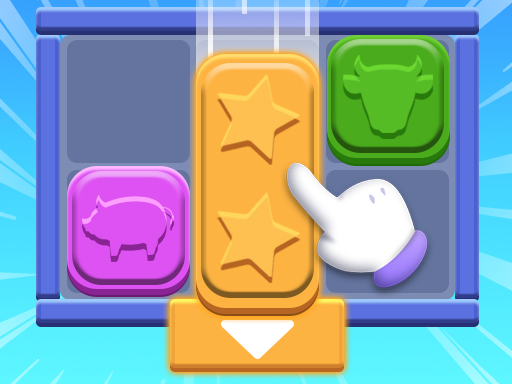
Color Wood Animal Jam is worth putting next to these two because it isolates the colour half and removes the clock entirely. It runs in portrait at 750x1334 and asks you to drag colourful wooden animal pieces into their correct slots, one click or tap at a time. There is no countdown and no disappearing floor - instead, a wrong placement jams the board and makes the remaining pieces harder to route.
Same input, opposite pressure. In the Robby games colour is a deadline; here colour is a constraint you can study for as long as you like, and the punishment for a mistake is a worse board rather than a fall. Playing one after the other is a decent way to feel how much of your performance in the elimination rounds was actually the timer.
Both Robby games sit in /category/obby/, and the slower colour puzzles are over in /category/survival/.