The vocabulary is small and worth knowing
Obby is short for obstacle course, and the genre inherited a compact set of building blocks from Roblox. Once you can name them you can read a level at a glance and predict where you are going to die.
Kill brick. A surface that resets you on contact. The design purpose is not difficulty, it is punctuation - a kill brick tells you which parts of the geometry are decoration and which are the path.
Checkpoint. The respawn anchor. The distance between checkpoints is the single most important number in an obby, because it defines how much progress a mistake costs. Short spacing turns a hard section into a drill; long spacing turns it into a gauntlet.
Moving platform. Introduces a timing window on top of a spacing problem. The jump itself is trivial; the question is when.
Conveyor. A surface that adds velocity you did not ask for. Conveyors are how designers make a straight corridor hard without adding a single obstacle.
Tightrope. A path narrow enough that lateral precision, not jump distance, is the constraint. Usually placed after a conveyor or a moving platform so two failure modes stack.
Which pattern each of these five is built around
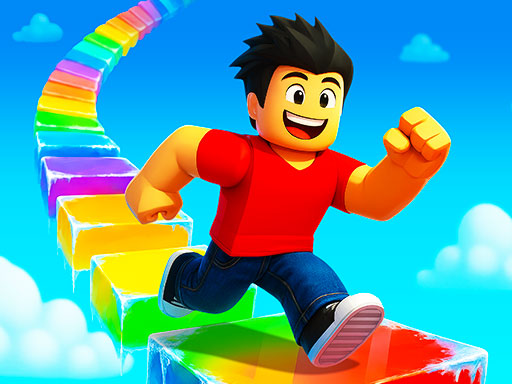
Obby Rainbow Tower is the purest stack of all five. It is a vertical, winter-themed tower at 960x600, and each floor mixes moving platforms, icy tiles that behave like conveyors, spinning lava bars as rotating kill bricks, surprise snowstorms and snowball portals that displace you. Crucially it is replay-oriented rather than checkpoint-oriented: the tower is meant to be run again and again against your own best time, so the whole climb functions as one long section. It has a proper double jump - Space pressed twice for Player 1, L pressed twice for Player 2 - and once you know that, several gaps that look like tightropes turn out to be skippable.
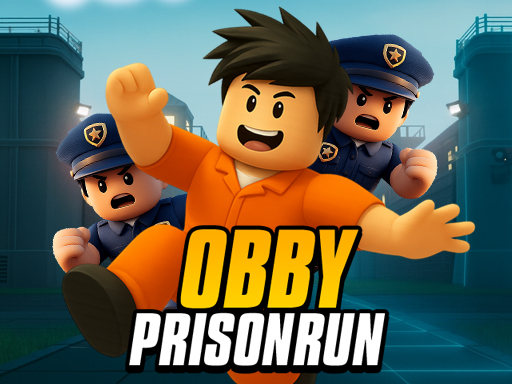
Obby Prison Run is the race-pressure variant, running at a compact 800x480. The traps are twisted versions of classic childhood games, and the framing is escape with rivals ahead of and behind you. Its control scheme is deliberately minimal - keyboard or on-screen buttons to move, nothing else - which tells you the design weight sits entirely in level layout and timing rather than in a move set.
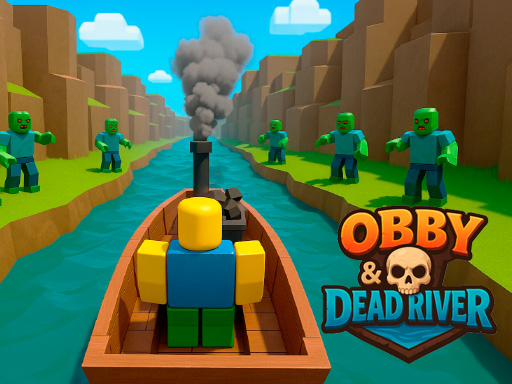
Obby & Dead River is the outlier: a first-person obby at 1920x1080 that grafts an RPG progression onto the pattern set. You move with WASD, jump with Space, run with Left Shift, free the cursor with Tab and open inventory with B - and that inventory key is the tell. Because you collect loot and upgrade the character, a section you cannot clear is not necessarily a skill wall; it may be a gear wall. The route runs a river past castles toward a final boss, with monsters, pirates and dragons in between, so combat interrupts the platforming rather than sitting beside it.
Snow Rider Obby Parkour replaces walking with a snowboard, which changes the pattern set fundamentally: you carry momentum you cannot cancel, so every obstacle is effectively on a conveyor. It runs at 960x600 and gives you two recovery tools most obbies do not have - C to change camera and R to respawn on demand (Player 2 uses L and U). Being able to self-respawn matters, because on a momentum game a bad line is unrecoverable long before you actually hit anything. It ships several modes, including distance records, an open world and downhill races.
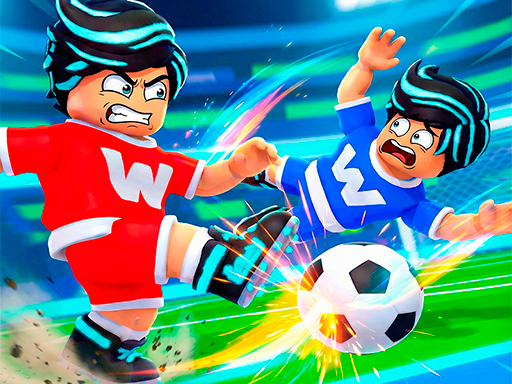
Obby Football Soccer 3D splits its time between obby courses and actual football at 1280x718, and it is the one with a real skill move set: Shift to sprint, Q to shield the ball, E for a sliding tackle, and left mouse to kick with power scaled by how long you hold. The obby segments there are framed as reaction and speed training for the matches, which is a neat justification for mixing the two.
Reading a level before you play it
The practical takeaway: look for the conveyor first. Icy tiles in Rainbow Tower, the board itself in Snow Rider - anything that adds velocity you did not input is what will actually kill you, and every tightrope placed after one is a two-failure-mode section, not a one. Then find the checkpoint spacing. If a game does not show you checkpoints, as with Rainbow Tower, treat the whole run as a time trial and stop optimising for survival.
The full obby shelf is at /category/obby/.